
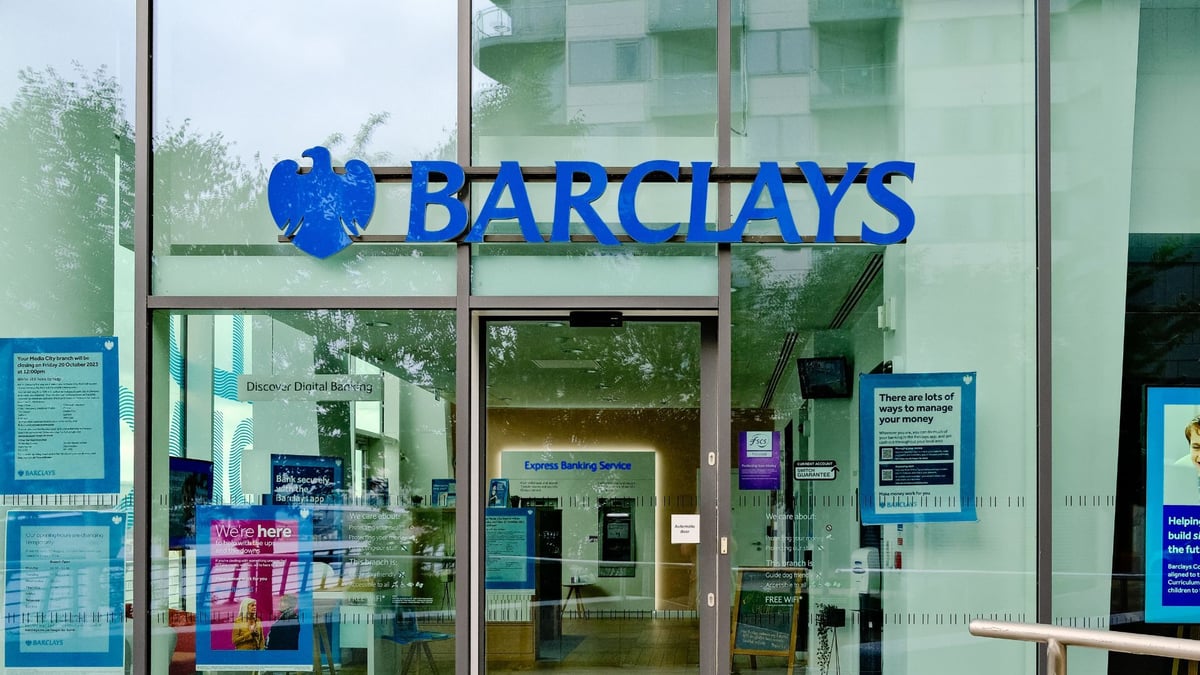
The choices a brand makes around where to show up are some of the most consequential in marketing. While online-only or ‘neobanks’ are gaining momentum, Barclays is embracing its physical presence – reopening branches and showing marketers that "the dream of omnichannel" is still alive
Meeting your customers where they are is a foundational rule of marketing. It’s the starting point for winning propositions that understand and respond to the needs of customers. Products or services that are priced right, marketed in places where you can reach them with messaging that will resonate, and distributed through the right choice of channels.
That last point – the literal interpretation of meeting your customers where they are – explains why distribution, or ‘Place,’ is one of the essential 4Ps of marketing, alongside Price, Product and Promotion.
Getting place right is crucial, but it’s rarely straightforward. The choices a company makes around distribution, as Mark Ritson explains on the MiniMBA in Marketing, has multi-layered implications.
First and foremost, it's about brand, he says. Profit and revenue are important too, but secondary considerations in the context of place. “Distribution has to be an almost perfect exposition of the positioning,” he says.
"Distribution has to be an almost perfect exposition of the positioning"
The retail banking industry has felt the implications of changing distribution choices over the past decade, with the emergence of digital-first banks (commonly referred to as neobanks) that have sought to capitalise on the growth of mobile as a channel.
With bank customers increasingly on their phones, the likes of Monzo, Starling and Resolut in the UK – and international peers such as Chime, Nubank and N26 – are now meeting those customers where they are: on their handsets.
It also explains why bank branches have been closing over the same period. According to Which?, the consumer research organisation, more than 6,700 bank and building society branches in the UK have closed since the start of 2015, equivalent to 68% of the total at the start of that period. It’s a shift that will be familiar to bank customers globally.
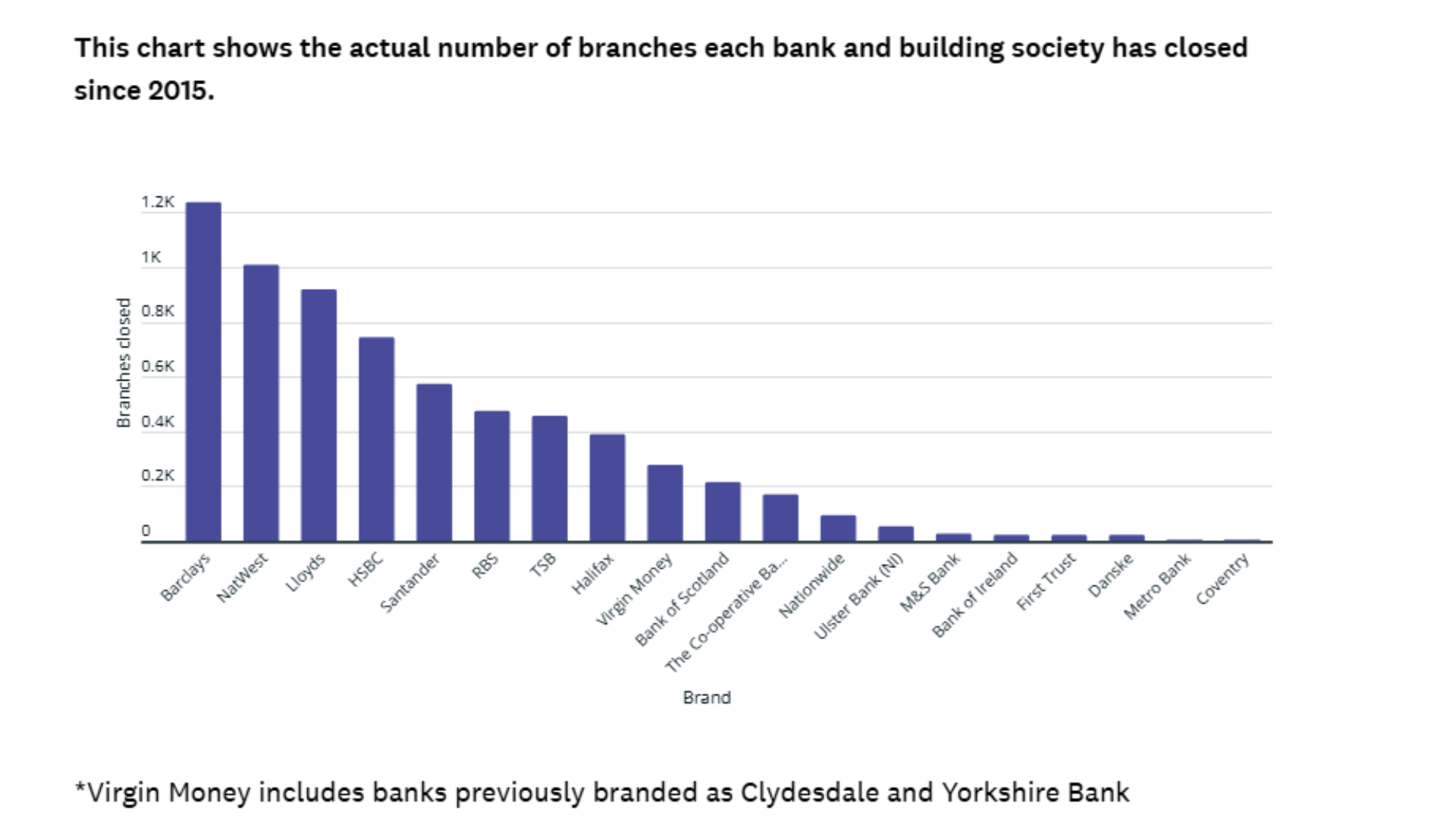
UK bank branch closures since 2015. Source: Which?
The scale of change is unsurprising given figures compiled by the UK’s Financial Conduct Authority, which showed high penetration of online banking and rapidly declining usage of high street branches.
In 2024, only 7% of current account holders didn’t bank online or using a mobile app, compared with 22% according to comparable research in 2017. Only 18% of respondents regularly used a specific branch, down from 40% in 2017.
In 2024, only 7% of current account holders didn’t bank online or using a mobile app
The shift from the high street to handset is clear and perhaps inevitable. How can our big, traditional banks, which typically grew scale with an on-premise, face-to-face retail model and which still, despite closures, carry the overheads of large branch networks, compete effectively with the new digital-first banks?
For Barclays, the UK-based banking group, the answer is to embrace its on-premise strength as a differentiator against the online-only competition.
In April, Chief Executive of Barclays UK Vim Maru told The Times he had paused bank closures and was now looking to add new branches. He said he wanted to “differentiate in front of our customers” and be there, in person, when they need help and support.
"the combination of great digital and great human touch is the future of banking"
This marks a significant shift for Barclays, which has closed more than 1,200 branches – nearly 80% of its estate – since 2015. This is substantially more than any of its competitors.
His comments suggest the bank is working towards creating an omnichannel experience for its customers: “the combination of great digital and great human touch is the future of banking.”
According to Mark Ritson, “the dream of omnichannel" is a model that marketers will frequently come across, but one that isn’t universally understood.
What is omnichannel distribution?
The term was invented by Darrell Rigby, Bain & Company consultant who predicted in a 2011 Harvard Business Review article that digital retailing would morph into an "omnichannel era," where companies would be able to interact with customers through a variety of channels, such as physical stores, websites and call centres.
Importantly, an omnichannel experience should, he said, be seamless and consistent at every point of interaction with the customer. That means the brand experience should be the same for the customer however they interact with the company, and their data should follow them too.
For example, if a bank customer has started a car loan application online and then walks into a branch, members of staff should have access to this information and be able to pick up where they left it online.
A truly omnichannel company is rare, though, Mark says. Better to consider omnichannel as an ideal and think about where a company is on its journey towards that ideal.
In Module 10: Distribution of the MiniMBA in Marketing, you'll learn why shifting to an omnichannel proposition takes place over three phases. Initially, a company is strong in its core channel (it is ‘mono-channel’). Then, it embraces new channels , such as telephone banking or online banking in Barclays’ case (it is ‘multi-channel’).
This can be a winning strategy if you get it right. But just showing up in multiple channels isn’t enough if you want a truly omnichannel offering.
To move beyond multi-channel into omnichannel distribution, the customer experience at each of these different channels must be executed to the nth degree. Finally, only once the whole experience is consistent and harmonious, the company achieves its omnichannel ideal.
"Imagine a retailer that was able to build your brand and make you money and generate revenues and recruit new customers and do it seamlessly across online, offline, in-store, everything. That's the dream of omnichannel, and it remains, for most brands, a dream," says Mark.
One advantage Barclays has is the scale of its branch network, which stands at 206 branches and would be hard for a digital-first bank to replicate.
Research from the US suggests that the physical distribution channel could prove an important element for banks. A study of US banking consumers in 2025 found that 64% of respondents would use bank branches to solve ‘specific and complex issues’, while 65% of respondents said seeing bank branches in their neighbourhoods confirmed the ‘stability and availability’ of those banks.
Barclays is not alone in seeking to build an omnichannel proposition
Barclays is not alone in looking to its branch network for future growth or seeking to build an omnichannel proposition. Nationwide, a domestic competitor, said in 2023 it would keep all its branches open until at least 2028, which it has since extended to 2030. It’s also working on plans to build an omnichannel experience for its customers.
HSBC is also investing in creating a best-in-class mobile app as it works towards creating an omnichannel experience that mixes a digital first approach with ‘in person when it matters’.
Distribution choices can be thought of in the context of brand, revenue and profit. Optimising for one might come at the cost of the others. For example, the closure of high street bank branches by the likes of Barclays served the profit ambitions (or maybe needs) of those companies, but came with a decade of negative news headlines, as communities lost their branches – not a great brand outcome.
Distribution decisions that prioritise revenue or profit risk damaging the brand, prompting a company to show up in a way that doesn’t fit with its strategy.
Distribution choices can be thought of in the context of brand, revenue and profit. Optimising for one might come at the cost of the others
Earlier this year, Bain & Company predicted that while many traditional banks are delivering record profits, their market share by revenue is slipping and set to slide further. Meanwhile, when Kantar conducted their 2025 analysis of banking brands with most momentum, it was a digital-first bank that topped the list.
Distribution choices are important and not the place for tactical experimentation. The choices Barclays makes now are fundamental to its ability to differentiate against competitors, and its hopes of acquiring, retaining and growing customers.
For marketers, this also illustrates the impact of distribution choices on achieving marketing objectives. Getting the place P right, as part of your marketing mix, must be a key consideration for every marketer.
Join Mark Ritson on the MiniMBA in Marketing and you’ll learn how to make the four elements of the marketing mix work for your plans. The next course starts in September '27 – secure your place here.
Cover: Paul / Adobe Stock