
Stop the press. A professional services business has pulled off a successful rebrand that wasn’t a complete waste of time
PwC has done the unthinkable; forced Mark Ritson to write a genuinely positive column about rebranding. It's a shame the same can’t be said about Walmart, who is attempting something similar with significantly less conviction.
In other news, Meta finds itself in a courtroom (again) for doing exactly what Meta always does. While the marketing industry finds something else to look at (again).
Lastly, Tim Cook will be stepping down as Apple’s CEO in September. Read on to hear Mark’s assessment of his successful and yet underwhelming time at Apple.
The Drum: Most corporate rebrands are expensive nonsense. PwC’s was not
When PwC announced a rebrand in early 2025, the world had every reason to believe what followed would be an expensive, disappointing and largely pointless piece of work.
“The new logo goes up, the press release goes out, the CMO goes large on stage, the agency gets paid. Then absolutely nothing changes. Old behaviours continue.”
After all, the news came shortly after a PwC Australia tax partner had been caught leaking confidential government tax information – a damaging global scandal.
What actually followed was, by Mark’s account, a considered and disciplined brand revitalisation.
The firm spent 18 months in research mode before taking any action. What came of this was genuine insight into what their customers believe PwC did for them.
“So You Can” is not a tagline someone wrote in a brainstorm. It is the direct verbal expression of something that clients actually said. And actually want.”
This campaign ran continuously in 100 countries across connected TV, digital out-of-home, Netflix, Hulu, and linear sport. A marketing team that understands the power of longevity in effectiveness and long-term brand building.
Visually, the brand modernised but kept core elements the same. With a brand as recognisable as PwC, “you build on what already exists in memory. You don’t ask the market to learn something new from scratch.”
PwC also coincided their visual rebrand with the launch of their Official F1 partnership “rather than waiting for a campaign to do the work.”
Not to mention that Antonia Wade, PwC’s CMO and Marketing Week’s Marketer of the Year 2024, had spent four years biding her time. “Demonstrating marketing’s commercial value to a global board before asking them to fund a brand revitalization in the middle of a reputational crisis.”
The lesson for the industry is that patience, real insight from your customers and protection of your most valuable brand assets is what it takes to get a rebrand right.
Rebrands are never a good idea. A brand revitalisation, however, is an honest re-examination of what a company is and does, and how that is portrayed to its customers.
The MiniMBA in Brand Management teaches marketers how to effectively manage, grow and protect their brand.
Download the course brochure today and learn more about core brand management modules behind a revitalisation like PwC's – including "the missing step in marketing plans: brand diagnosis."
The Drum: Walmart is refreshing its private labels. It could learn from Tesco
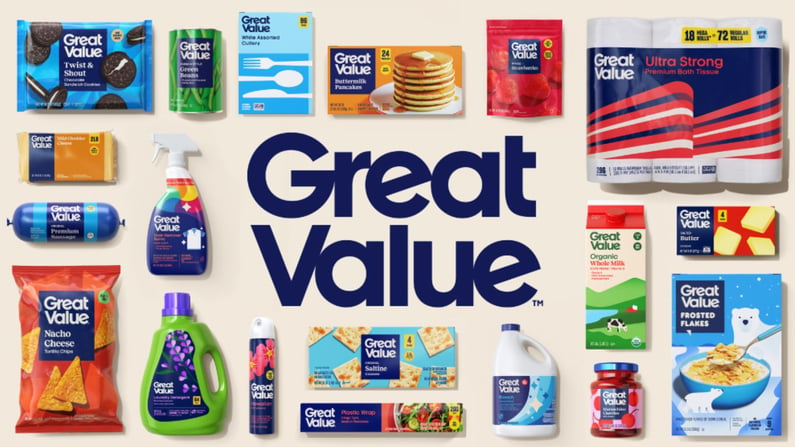
Walmart recently announced they were giving their private label brand, Great Value, a refresh. Launched in 1993, generating $27bn in revenue and penetrating more than 85% of American homes, Great Value is the most successful private label in America.
This all sounds impressive until you realise that in America, private label sales account for roughly a quarter of total grocery sales. In comparison, the UK’s biggest grocer, Tesco’s private label accounts for 44% of total grocery spend. And it's not just the UK where private label dominates.
In Europe, private label accounts for 46% in Spain, 45% in Portugal and the Netherlands, and 42-43% in Belgium and Germany. So why is the US so far behind? According to Mark, there are 3 main reasons.
The first, American manufacturers like P&G, Kraft and Coca Cola are better at brand building and maintaining share of voice than anyone else on the planet. So much so that branded grocery is now the standard and store brands are the sloppy second.
Second, the American grocery market is more diluted than Europe. The top four US grocers hold a third of the market where the top four UK grocers hold three-quarters. “Private label needs scale and category control to fund the quality, R&D and design that lift it out of the bargain bin.”
Third, “US retailers shot themselves in their own private-label feet. They have consistently positioned their own-label offerings as the cheap option for decades.”
The thing that the US are clearly a bit late to realise is that private label is a ‘quadruple win’ as Mark calls it, carrying double the gross margin of branded counterparts. “And it builds the most valuable kind of customer loyalty, loyalty that the customer cannot physically exercise at a competitor.”
To truly achieve success with its private label, Walmart needs to properly build the brand architecture within the private label, invest in the products, market them with above-the-line budget and delist branded competitors from their shelf real estate when own label is genuinely better.
“If America’s largest retailer genuinely wants Tesco-sized margins, it is going to need Tesco-sized ambition and proficiency. Not just a nice, new label.”
If Walmart really plans to grow its private label, it needs to do more than a cosmetic refresh.
The retailer must first invest in its brand positioning, architecture and long-term brand building, disciplines taught by Mark Ritson on the MiniMBA in Brand Management. The MBA-level course designed to make marketers immediately better and more confident.
ADWEEK: Tim Cook Grew Apple by Reducing Its Ambition 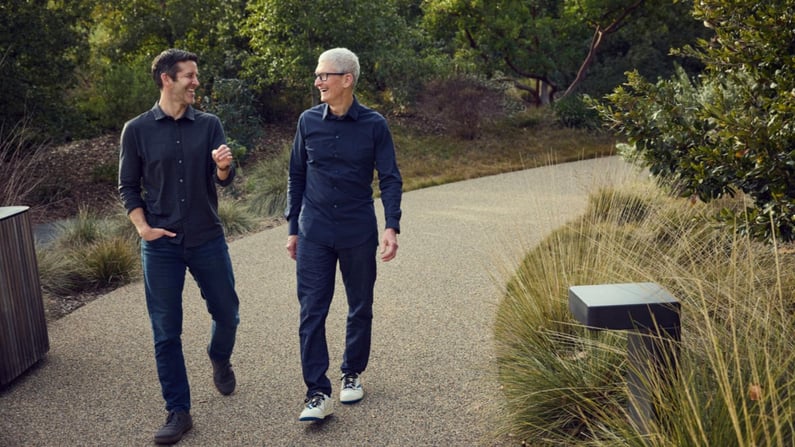
Tim Cook and John Ternus at Apple Park
Tim Cook had big shoes to fill when he succeeded Steve Jobs two months before his death in 2011.
With his exit date announced for September this year, Mark used his recent column to weigh in on Cook’s reign at Apple so far. His short and sweet assessment? “Cook is a superb operator and a competent strategist who has been a mediocre product visionary.”
When it comes to profitability, no one has done it better than Cook. When he joined, Apple’s market cap was around $850 billion and today it sits at $4 trillion. “Cook’s Apple is the most financially successful company in human history.”
Cook also expanded Apple’s geographic reach, built Apple Services into an $85 billion annual revenue machine and firmly planted Apple on the right side of privacy, making it a genuine differentiator.
“He shepherded Apple through a global pandemic, a semiconductor shortage, and a supply chain crisis, and came out the other side with margins that made competitors weep.”
However, Cook’s Apple did miss the mark in two crucial areas.
Whilst the Apple Watch and AirPods are both strong, profitable products, nothing Apple has done in the last 15 years has redefined its category like the iPhone.
“He has maximised the value of what Jobs built, but has not meaningfully extended it into new territory. He saved the church. He just hasn’t delivered a new gospel.”
The second shortcoming of Apple in the last decade is its reaction, or lack thereof, to AI.
For a company whose brand is built on three pillars: simplicity, humanity, and creativity, Apple should be dominating AI. “Instead, Siri is an idiot in a classroom filled with geniuses.”
The big question of “What will do Apple do next?” is aimed at John Ternus, who is set to take over as CEO in September this year.
Whilst the iPhone was a tough act to follow, it appears Apple has neglected the most important P of marketing, Product.
Read how the MiniMBA in Marketing helped Boundless turn “their weakest link” to a new and improved product offering that enabled them to increase prices and win an IPA effectiveness award.
ADWEEK: Meta Has Made Child Exploitation a Cost of Doing Business
Last month, Meta was found liable for fuelling the depression and anxiety of a young woman who had obsessively used their platforms as a child.
This came just one day after the company had been ordered to pay $375 million in New Mexico for violating consumer protection laws and endangering children on its platforms.
This is not Meta’s first appearance in the courtroom. The most famous being the Cambridge Analytica scandal of 2018, when the data of 87 million users was used by political operatives without consent. The $5 billion penalty was the largest privacy fine in American history.
Not forgetting the €1.2 billion from Ireland for GDPR violations and the $1.4 billion from Texas for collecting facial scans without consent.
And we can’t forget the Facebook Papers. “Thousands of internal documents confirming the company’s own researchers had found Instagram was psychologically damaging to teenage girls, that the platform was algorithmically designed to maximize outrage because outrage kept people scrolling, and that leadership had read the findings, nodded, and carried on.”
It all seems shocking until you remember Meta started as a website used to rate the physical attractiveness of female students at Harvard using photographs scraped without consent.
Yet somehow, Meta will continue, uninterrupted and unaffected. In fact, Meta’s ad business is doing so well that it is projected to beat Google's annual ad revenue this year at just shy of $250 billion.
“Not one CMO, not one holding company, not one trade body has seriously questioned pausing Meta spend in the wake of two child exploitation convictions.”
As an industry, we have given Meta the gift of institutional immunity. It has become such an integral part of performance marketing that it is almost impossible to imagine a media plan without it.
“Two convictions for child exploitation on its own platforms, and the marketing industry collectively moved on. The dashboards loaded. The campaigns ran. The checks cleared.”
Brand salience is one of the most powerful forces in marketing. In Meta’s case, it's also one of the hardest to question or deviate from once it's established.
Module 1: The What & Why of Brand in the MiniMBA in Brand Management explores how brand equity and salience really work, and what it means when the two come apart.
Images (from top): Apple, Walmart, Askar/Adobe Stock