

Christmas ad season has begun and so has Mark’s disdain for marketers who insist on change. Who am I kidding? That doesn’t wait until the holidays.
Four recent columns from Mark Ritson, with two distinct themes.
AI’s increasing presence in our lives and job roles has got marketers in a fluster. New marketing strategies are being developed to target AI agents (you know, the ones designed to mimic human behaviour). All the while, the ‘AI or not’ debate is heating up with every new Christmas ad.
And whether it’s ads, slogans, or any other distinctive brand asset, marketers are getting bored of their creative long before customers even notice it, which prompts Mark to create his own slogan: ‘You are not the customer’.
ADWEEK: The AI-or-Not Debate Is Advertising’s Most Pointless Argument
 Photo: Zulfugar Zarimov/Unsplash
Read the full article on ADWEEK
At the start of November, Dior released its Christmas ad, “Christian Dior’s Night in Color”. A beautiful, hand-illustrated film, featuring the voices of Robert Pattinson and Rihanna, tells the story of Christian Dior creating a dress for Marlene Dietrich in 1949 Paris.
But viewers were quick to notice warped letters and additional limbs where there shouldn’t be. Bold claims of AI generation followed, from online critics and studio professionals.
Whilst the director, Sylvain Chomet, has acknowledged the use of generative AI to smooth out the animation, Dior has neither confirmed nor denied.
So now Dior is in a bit of a pickle. Not because it used AI. As Mark points out, the line between ‘AI or not’ is becoming as blurred as the dodgy animations that fuelled the fire in the first place.
“The monochrome disparity of real and artificial ended around 2024, a gradient that runs from a bit of noise reduction at one end to a creature imagined and drawn entirely by machine at the other.”
The problem Dior has is twofold. First, Dior’s creative director made a hoo-ha about the film being “entirely hand-made”.
Second, care, quality and human creativity sit at the core of a luxury brand like Dior, so being caught out on a claim of craftsmanship does particular damage.
“Luxury, more than any other category, cannot afford to be caught out. A mass brand can get away with it because nobody expects a Doritos ad to be drawn by monks. But luxury sells provenance first and product second, so provenance is the product, and a story about hands that turns out to be about graphics cards doesn’t just damage an ad’s reception, it invites people to revisit how they think about the brand.”
Brands get caught out when their actions do not align with what they say and stand for. Knowing what your brand DNA is, and protecting it in everything you put out, is at the heart of the MiniMBA in Brand Management, starting with Module 3: Brand Diagnosis.
The Drum: Mark Ritson: AI agents don’t need their own marketing strategy
 Photo: Immo Wigman/Unsplash
Read the full article on The Drum
Mark recently attended The Drum’s B2B World Fest. Like most marketing events of the last few years, the conversation was largely about AI. And the latest hot topic in AI is agents.
If you haven’t heard, tech and consulting firms are imagining (and conveniently selling) a future like this:
“Very soon, the customer will not be shopping. Their AI agent will. It will do the searching, the comparing, the shortlisting and eventually the buying. The human will just get a box on the doorstep or a signed contract in their inbox. Ergo, marketers must stop marketing to people and start marketing to machines instead.”
Now, there’s no doubt AI is changing every aspect of marketing, but Mark argues that agents are one part of AI we don’t need to become obsessed with. And certainly not one we need an entirely new strategy for.
Researchers created mock environments mirroring different points in the marketing funnel, and the big AI models are replicating human decision-making more consistently than humans do.
“The agents went for the products at the top of the page with a badge and the cheaper ones with better ratings and more reviews. Sound familiar?”
Ahrefs, a leading SEO and search platform, analysed 75,000 brands and found that the biggest predictor of an AI mentioning a brand was how often it’s talked about across the web.
“AI has read everything we ever wrote, so it likes what we like. It knows the famous brand. It trusts the well-reviewed one. It notices the one at the top. AI comes very close to non-AI.”
In other words, agents buy like we do because they learned from us. According to Mark, a separate agent strategy is this year’s version of marketers developing an ‘NFT strategy’.
Mark’s advice is to stick to what you know. Build a brand people know, a product they rate, a fair price and a visible spot on the shelf, and the agent will follow the human. Without the additional ‘agent strategy’ consulting fees.
You don’t need an agent strategy; you need marketing done properly. The MiniMBA in Marketing covers all of it, from developing your strategy with Targeting, Positioning and Objectives, to building the 4 Ps (Product, Price, Place, Promotion), so you’re found and chosen by humans as well as agents.
ADWEEK: Amazon’s New Christmas Ad Is a Bet Against Itself
 Photo: Wicked Monday/Unsplash
Read the full article on ADWEEK
In 2023 Amazon first launched its Christmas ad, “Joy Ride”. You’d recognise it. Three old ladies sledding down a snowy hill on seat cushions ordered from Amazon, as if they were children again. The ad scored 5.8 stars from System1 for its effectiveness, basically a perfect score.
Then last year Amazon did something very unusual for big marketers: they reused the same ad. This time it got 5.7 stars. A score achieved by less than 1% of all ads that year.
“When System1 looked at more than 50,000 ads, it found that scores barely move as ads get older, and that some of the very best actually improve as people get to know them.”
Fast forward to this year, and Amazon has released a new holiday ad, “Joy Delivered”, which you can watch here.
While the ad is sincere, funny and warming in all the ways you’d expect of a Christmas ad, there is a problem. It was made by marketers. Marketers that experience wear-out far sooner than their customers.
“The average brand building campaign reaches its maximum impact about two to three years into execution. Seasonal stuff can often, as Coke has proved, live on for decades. But the average marketer is tired of their ad, and wants to make something new.”
Mark warns that marketers need to practise more patience and remember that they are not the customer. Just because you’re sick of looking at the same ad, slogan or distinctive brand asset, it doesn’t mean your customers are. Chances are, they haven’t even properly noticed it yet.
Amazon’s marketers wanted a new ad but its customers were still enjoying the old one. Remembering that you are not the customer, and letting data guide your decisions rather than your own judgement, is the heart of Module 1: Market Orientation in the MiniMBA in Marketing.
The Drum: Like a good neighbor, a good slogan is always there
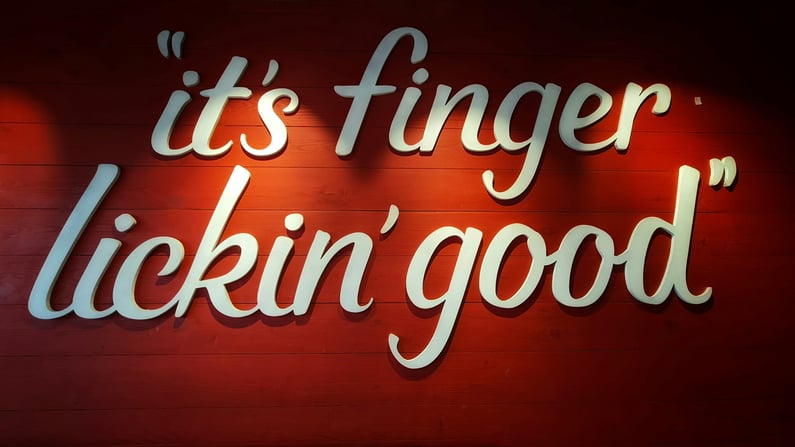 Photo: Syed Hussain/Unsplash
Read the full article on The Drum
Staying on the topic of impatient marketers, the consulting firm Distinctive Bat recently published the results from its study of over 1,000 slogans.
Conducted using a representative sample of 3,000 US consumers, Distinctive Bat scored slogans based on recognition and correct brand attribution, subtracting points for misattribution, to see which slogans actually last.
Distinctive Bat is clear to point out that its research focuses on how recognisable a brand is from the slogan, which is the number one job of a distinctive brand asset.
“Like every distinctive asset, the slogan is taken for granted, underused and, as soon as a new marketing director arrives, up for replacement. The marketer gets bored long before the customer does. Slogans like all other marketing fare are replaced too frequently by marketers who don’t know marketing and have a child’s appreciation for time.”
Among the top 10 most distinctive slogans were KFC’s ‘Finger Lickin’ Good’, Kellogg’s ‘Snap! Crackle! Pop!’, Nike’s ‘Just Do It’ and at number one, State Farm’s ‘Like a Good Neighbor, State Farm Is There’.
So what do these slogans teach us? First, longevity. “Eight of the 10 were written before 1972, which looks like proof that slogans were better in the old days. They weren’t. They’re there because nobody changed them. The inconvenient truth of brand building is that it takes decades, not months, for our work to properly take hold.”
Second, slogans perform best when they are attached to something else, like the golden arches or three elf-like mascots, and when they are embedded in the creative instead of an afterthought in the final few seconds of an ad.
Lastly, the study points a bright spotlight at the brands not using their slogans, even when they are some of the most recognised in the world. Has anyone ever heard McDonald’s use ‘Look for the Golden Arches’?
“The lesson from State Farm and, indeed Distinctive Bat’s whole report, is really not that complicated. Find a line, own it and keep saying it long after everyone in the building has stopped thinking it’s cool and exciting.”
A slogan is one of your brand’s distinctive assets, and as State Farm shows, it only works if you keep it over decades, not months. Read how to build your palette of distinctive brand assets, then learn how to properly apply and protect them in the MiniMBA in Brand Management.
Cover: Doriana Popa/ Unsplash