
Empirical research from Mark and Ipsos pulls the cover off the marketing knowledge gap, plus the future of AI marketers, the metaverse and more in the latest Ritson round-up...
If you haven’t seen Mark on your LinkedIn recently talking about how ‘marketers need to know more about marketing’, where have you been?
Ipsos surveyed 1,226 marketing practitioners across the UK, US, Canada and Australia, and the results show two-thirds of marketers would fail a basic marketing knowledge test. If you know Mark, you know he isn’t going to let this go lightly.
But fear not, there is a light at the end of a bleak tunnel, because April means MiniMBA courses are starting! We are welcoming a new cohort of hungry marketers into the virtual classroom over the coming weeks.
If you want to get a piece of the action, it’s not too late. Make 2026 the year you upskill yourself. Or here’s a better idea: ask your company to use some of their training budget to fund your place on the course.
Not only will you immediately become a better, more effective marketer (which benefits them), you will also regain your confidence and hunger for our craft.
If you want to talk to our team about booking a place on our April course, reach out to us here.
Or secure your space in the virtual classroom now.
The Drum: Unlikely teammates ITV and Sky show where TV is heading

Read the full article on The Drum
In Manchester City’s recent defeat of Arsenal in the Carabao Cup final, there was an unlikely sight in the top-right of the screen. UK broadcast rivals, ITV1 and Sky Sports, side-by-side, working together like teammates during the 90-minute game.
The TV broadcasters agreed to simulcast select Carabao Cup and EFL Championship matches in a deal made in January 2025. “The logic is straightforward. Sky has the pay-TV subscribers. ITV has the free-to-air reach. Sharing the final gets both a bigger combined audience than either would attract alone.”
It’s likely this has something to do with the possible sale of ITV’s broadcasting business to Comcast (the company that owns Sky), but there is more to it than that.
Over the last two decades, the world of TV has changed indefinitely. Back in the day, BBC, ITV and Channel 4 used to compete amongst themselves.
“The BBC was dominant, ITV a clear second, Channel 4 a credible third. The market looked stable. Efficient.”
Bruce Henderson, the founder of Boston Consulting Group, called it the ‘Rule of Three’. “A stable, competitive market never has more than three significant competitors.”
Now, they have Netflix, YouTube, Amazon Prime and Disney+ to worry about. And worry they should. In 2024, Netflix overtook ITV1 in monthly audience reach and even edged past BBC1 towards the end of the year.
And it’s not just the UK. Germany’s two public broadcasters, ARD and ZDF, and the ‘Big 3’ in the US (NBC, CBS and ABC) are losing audiences to their new streaming rivals.
So, what does the future of TV look like? We're not sure yet, but the Sky-ITV entity is the first major example of consolidation amongst legacy broadcasters, and that working together is a better option than competing for a declining slice of the market.
Sky is also making a bid to diversify against the big streamers, wrapping four high-profile streaming services – Netflix, Disney+, HBO Max and Hayu – into its headline TV package. Read: Sky reminds us why marketers shouldn’t underestimate product improvement.
Sometimes half the pie is better than nothing at all. Learn about brand extension, diversification and consolidation in Module 8: Brand Architecture of the MiniMBA in Brand Management. Our April intake is starting soon.
ADWEEK: 65% of Marketing Jobs May Not Survive AI
Read the full article on ADWEEK
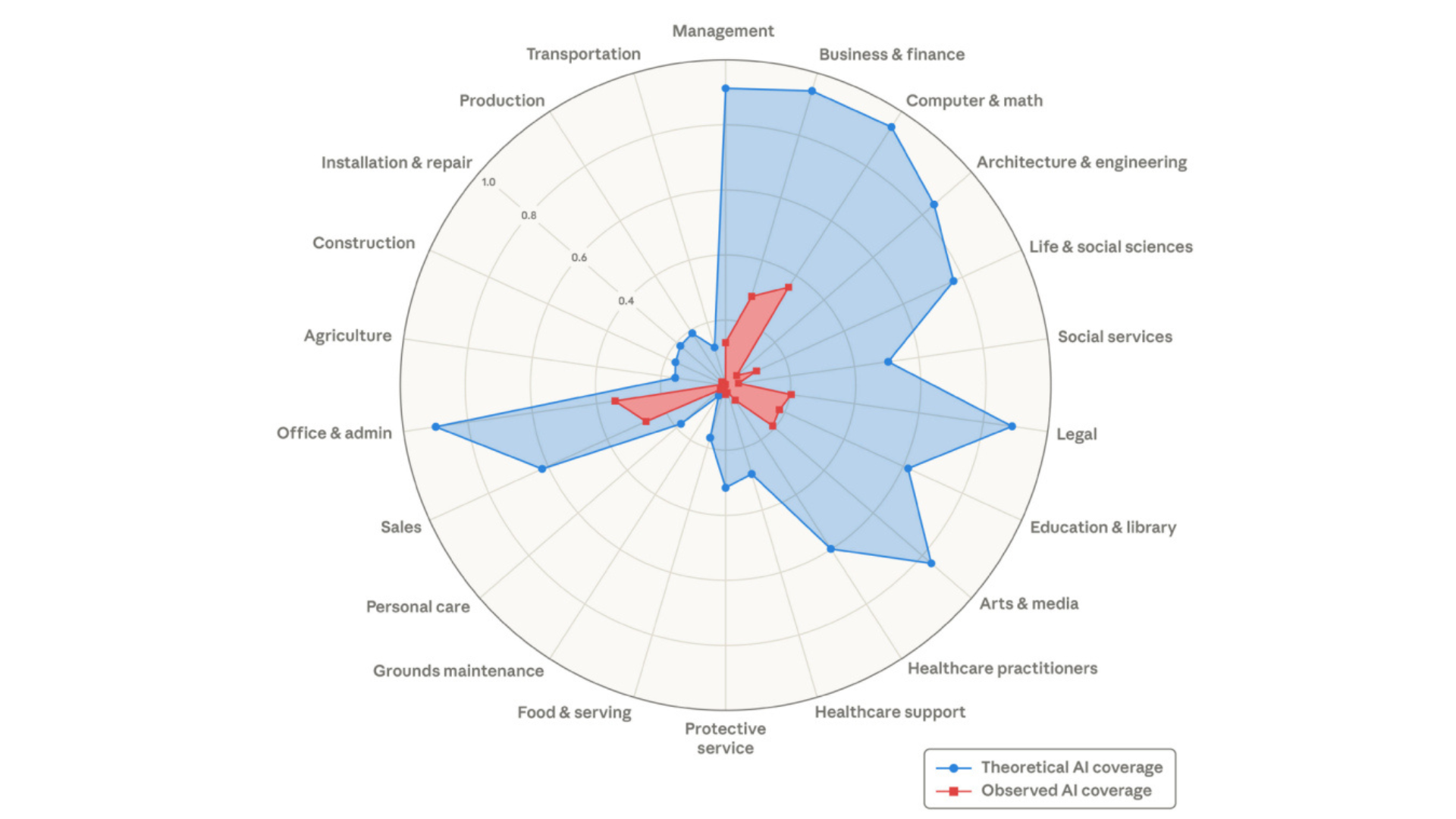
Last month Anthropic, the company behind Claude, released its Labor Market Impacts report.
Their findings project an unsettling future for the marketing job market, with an estimated 65% of tasks performed by marketing professionals eventually being replaceable with AI operations.
“Commissioning and interpreting consumer research. Analysing data. Sizing markets. Segmentation. Brand strategy. Positioning. Pricing.” AI can already do a lot of this quicker and more accurately than many marketing teams.
The Bureau of Labor Statistics also projects that occupations with higher AI exposure will grow more slowly over the next decade. We’re already seeing this come to life, with marketing job postings in the US down by 7% in 2025.
When available job roles drop, people stay put and the job market stagnates, which means roles stop being backfilled. But that's not the worst of it. “With fewer marketing jobs existing and fewer people leaving the ones that do, salaries do not keep pace.”
“The 2025 CMO Survey – an independent U.S. study tracking 281 marketing leaders – found median marketing salaries stayed flat last year: a decline in real terms against inflation.”
Perhaps the most disturbing detail in the Anthropic report is the workers affected are disproportionately younger and earlier in their careers. A senior marketer with 20+ years' experience, knowledge and client relationships is harder (and more expensive) to replace than an entry-level marketer.
So, if you’re under 40 and work in marketing, here’s what Mark thinks you should do:
- Train up. Learn your field, make yourself as indispensable as possible.
- Move up or move out. Junior roles will disappear first so move up as quickly as you can or consider changing roles.
- Learn AI properly. Become fluent and confident in it. Use it to double, triple and quadruple the quality and quantity of your work.
AI can deliver a 95% match to real survey results, so it’s time marketers learn to work with AI, not against it. Learn how you can use AI and synthetic data to conduct your market research.
The Drum: Meta can kill the metaverse. It can’t escape the name

Read the full article on The Drum
Meta announced last week that Horizon Worlds, the virtual reality platform that was going to be ‘the next chapter for the internet’, will be shut down in June.
“Eighty billion dollars and four and a half years later, the metaverse is officially dead.”
Not only is this pretty humiliating for Zuckerberg, who in 2021 told the world he expected 1 billion people to work, shop, play and socialise in the metaverse.
It also highlights the stupidity of changing the entire company’s name to Meta. At the time, Zuckerberg said “I want to anchor our work and identity on what we’re building toward.” How is that working out for you now?
The move wasn’t entirely stupid. The Facebook brand was damaged so the company was right to introduce a new brand architecture that separated the product from the corporate entity.
Google did the same in 2015 when they created Alphabet, “an empty holding company name that allowed different businesses to do different things, unencumbered by the specificities of brand meaning.”
Also, it’s easy to assume Zuckerberg acted alone in his quest for the future but “most of the marketing and consulting ecosystem followed him at full speed, naked, into the same void.”
Conferences were invaded, brands opened virtual stores and waited for customers and Bloomberg predicted an $800bn market. But the ship sank, and Zuckerberg and his team are left to carry on the company name in quiet embarrassment.
Meta has 2 options according to Mark, both of which are not great. He can wait for semantic numbness, for everyone to see Meta as the (slightly sinister) global corporation it is. “That sounds sub-optimal, but it is considerably better than being the company permanently named after the most expensive tech balls up in history.”
Or they can rebrand (again), which will cost hundreds of millions, but the reputational cost is likely bigger. “A second rebrand within five years signals to the world that you cannot be trusted to know what you are or what you are building.”
“So now he sits, staring at his company’s name and deciding whether to change it again, or suck it up and look slightly silly for another quarter century while Meta gradually dissolves all its negative connotations.”
Let this be a very important lesson to you. Rebranding is almost always the wrong move, especially if you decide to name your entire company after its biggest failure.
Learn why rebranding is a quickest to tank brand equity on Module 5: Positioning of the MiniMBA in Marketing.
The Drum: Britain has a marketing knowledge problem

Read the full article on The Drum
Earlier this year, Mark worked with Ipsos, the global market research company, to build a representative study of basic marketing knowledge amongst British marketers.
The team surveyed 317 UK marketers, asking them 10 undergraduate questions with 4 multiple-choice answers. And the results were not promising...
“Only 31% of British marketers could identify a quantitative research method. Fewer than half – 48% – knew what Distinctive Brand Assets meant. Only 42% understood ESOV. Just 53% could correctly define penetration. And on the question of STP – Segmentation, Targeting, and Positioning, the absolute bedrock of how we think about markets – a third of British marketers drew a blank.”
Across the pond, the results weren’t much better. Two-thirds of American marketers would fail the most basic test of marketing knowledge.
Read next: 65% of marketers fail to meet basic
knowledge benchmark, reveals Ipsos study
When analysing the data, the team looked at all the obvious variables – role, sector, seniority, age. None of them had a statistically significant effect on whether a marketer passed or failed, except one. Formal training.
“The Ipsos data shows that formally trained marketers are 15 percentage points better at advocating for budget. They are 17 points more likely to report career happiness. They are 18 points more likely to still be working in marketing in 10 years’ time. They lead more influential teams, build better institutional knowledge, and feel better incentivized in their roles.”
And yet, in marketing, we have fallen into dangerous waters. “You will hear, usually from someone quite senior, that they never had any formal training and they did just fine. That the best marketers are instinctive, not academic.”
Whilst there are great marketers who have built incredible careers without formal training, and our line of work doesn’t legally require specific training, that does not give us a free pass.
The data says everything we need it to say – formal training makes marketers better.
See how you fare against your marketing peers and take the marketing knowledge test here.
Or better yet, do something about it with MiniMBA. Our courses start this month and there is a seat for you in the virtual classroom. Join our April cohort now.
Images (from top): Sky Sports, Anthropic, Mark Zuckerberg/Meta, sitthiphong/Adobe Stock