
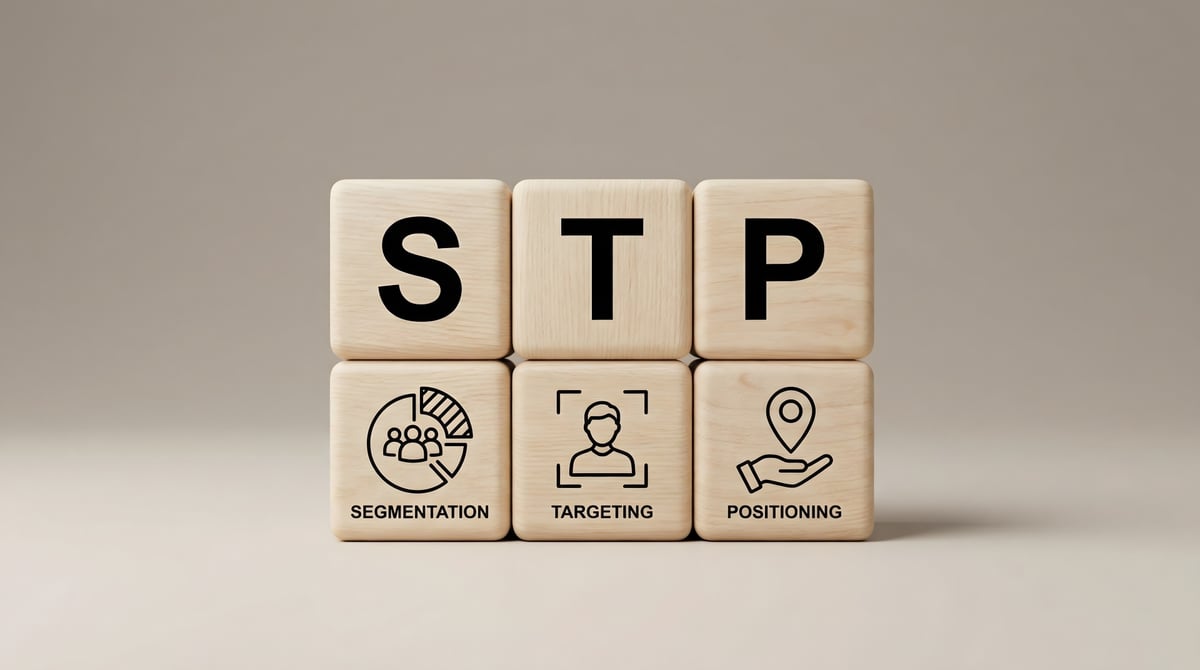
Building a well-defined and valuable segmentation is the starting point for building a marketing strategy that works. But are your team up-to-speed with what good looks like and ready to effectively target and position your company, brand or offer?
If you sat down with your team and asked each person to map out on a piece of paper what the market you serve looks like and which bits of that market you’re focused on, what would you get back?
Would everybody around the table confidently be able to attempt a segmentation of your market – and describe it as that? Would they be clear on which of those segments are a target – and, perhaps more importantly, which are not?
You might hope that each team member would be able to articulate how you seek to position your company, your brand or your products to those target customers. But could they?
Segmentation, targeting and positioning are the foundational principles of marketing. This is the language that, as marketers, we should be deeply familiar with; these are the concepts that should underpin everything we do. However, recent research with 1,226 marketers by Ipsos concluded that the terminology isn’t universally recognised.
The market research company’s Marketing Anchors report, released in March 2026 , found that when asked what marketers are referring to ‘when they talk about STP’, only 66% of respondents picked out ‘segmentation, targeting and positioning’ as the correct answer from a list of four options.
The same people were then asked to define ‘brand positioning’. Only 61% of respondents selected the correct answer from four options, suggesting that even where people were able to put a name to the concept, not all those people could properly define what that concept means.
In a team of ten marketers, that’s equivalent to three, maybe four, people in the team being unclear on the basic language of defining your market and then setting a marketing strategy. If put to the test, how many in that team would then struggle to apply these fundamentals in an effective manner?This matters, of course, because companies that invest in training their teams can expect every marketer on the team to understand the language, to define the language and to apply it effectively. Trained well, nobody should be falling short of that measure.
Understanding the language of segmentation, targeting and positioning is important because, as Mark Ritson teaches on the MiniMBA in Marketing, consumers don’t behave as an “homogenous army”, with the same motivations. If you want to build effective campaigns, you need to “reveal the complexity” of your different customers. It’s only by putting together a proper segmentation of your market, grouping customers by their different attributes, that you can start to think about which customers to target and how.
Recognising the terminology of segmentation is crucial, but understanding what a good segmentation looks like is important too. The same goes for targeting and positioning: recognition without understanding isn’t enough.
Knowing what ‘good’ looks like
In my experience of leading marketing teams, there are differing views on what good looks like and how much detail a segmentation should contain.
You might have come across companies that segment their market by demographics. A company that claims to be ‘targeting gen-Z’ or any other broad demographic group has failed to build a deep understanding of its market. How can you look at a huge group of people in wildly different situations – in the case of gen-Z, from teenage children to people in their late 20s – and effectively target them with a single approach?
The MiniMBA in Marketing teaches teams how to build a segmentation around customer attributes that matter, such as attitudes and behaviours. For example, their motivations for buying or how frequently they buy. Every situation is different and the best choice of attributes will depend on the dynamics of the market.
A tourist town café, for example, might segment its customers according to how frequently they visit the location, whether they’re already regular visitors to the café, whether they typically order food and whether they tend to visit alone, with somebody else or in a larger group. But that segmentation would be irrelevant to a neighbouring gym, even if they have customers in common.
The MiniMBA in Marketing also explores why this approach is the best approach to segmentation and sets your team up to work more effectively, using the same language and the same models.
Regardless of the choice of attributes, a segmentation model should put a value to each segment – the revenue opportunity – and show the number of customers in that segment.
The tricky part of creating a segmentation can be working out which attributes really matter to your business and which ones you can act on. The age of your customer, for example, might be an important attribute and splitting your market in this way helps you find the most valuable groups of customers. But age might bear no relation to how valuable a customer is – it might not be a meaningful attribute. Your chosen attributes also need to be actionable: if, for example, you wanted to reach people who defined themselves as ‘brave’, how would you go about finding those people? Maybe better to find people who like skydiving or climbing mountains.
Teams enrolling on the MiniMBA in Marketing course are taught how to use Mark Ritson’s meaningful x actionable grid, a practical tool they can use in their businesses straight away. The grid helps marketers work together – in the team and with other stakeholders – to determine the extent to which attributes are genuinely important (meaningful) and the extent to which they can be used to identify potential customers (actionable).
Even the best agencies can’t replace a proper understanding of the marketing fundamentals
It’s common for companies to bring in an agency to support in this area, especially if the work involves investment in market research. However, outsourcing the work doesn’t dilute the importance of internal teams understanding the detail of how your segmentation is built. Your marketing team might end up with an incredibly detailed segmentation but be unclear on how they translate that into creating effective campaigns. They need to be confident that the choice of attributes is both meaningful and actionable – and willing to champion the segmentation to others across the company. They also need to be excited to use it to create better campaigns.
While segmentation is important, it’s not strategy – it’s simply a means of mapping out what your market looks like. Your strategy comes next in combination of targeting and positioning.
Choosing which segments to target isn’t always straightforward. While your segmentation should show the biggest revenue opportunities, you will want to consider the number of companies in that space, how efficiently you can sell to them and how well suited your offer is.
You might also choose to target defensively if, for example, you fear a competitor could easily steal your customers in a specific segment. There might also be segments that are small, but which fit well with the broader corporate strategy.
Targeting is, importantly, also about deciding which parts of the market you won’t focus on. It’s about making firm choices and focusing your efforts. It’s also crucial that everybody in the team, and in adjacent teams, buys into the targeting choices. If the marketing team wants to focus on small companies but the sales team wants to focus on big companies, the potential for dissatisfaction feels high, with neither team in a place to support the other’s activity.
A brilliant segmentation and strong decisions on targeting will mean nothing, though, if your team can’t get positioning right. Everything else falls apart if, when you put your messaging in front of your target customers, it doesn’t work. If your marketers don’t have a clear positioning and they don’t have a positioning that is right for those target segments, it won’t work.
Marketers need to understand how they position their products and be certain that their positioning is right. That’s why it’s worrying to see only 61% of marketers in the Marketing Anchors research by Ipsos able to correctly define positioning.
It’s also why the MiniMBA in Marketing teaches the importance of positioning and how to do it right.
There was one big predictor in the Ipsos research of which marketers would do well: whether or not participants had undertaken marketing training. Those who were self-trained tended to display weaker scores, with only 52% able to expand on ‘STP’ (vs 66% for all respondents) and 56% able to define positioning (vs 61%).
Across all questions, only 35% of all participants met the basic knowledge threshold (seven correct answers from ten questions), but this figure fell to 9% for self-trained marketers. By contrast, trained marketers significantly outperformed self-trained peers, with 40% getting a score of seven or more.
The Ipsos study illustrates the value of investing in marketing training. The questions around segmentation, targeting and positioning show the importance of making sure that everybody in your marketing team is speaking the same language and comfortable defining and applying those concepts.
If you want your team to build stronger strategies, make better targeting decisions and create more effective positioning, investing in a shared understanding of the fundamentals is a practical first step.
To help your organisation build that capability and give your marketers the tools and confidence to apply STP effectively, download a MiniMBA for Teams guide or speak to our training team.
Cover: Gambar/ AdobeStock