
Mark Ritson digs into new global research from System1 on the surprising power of audio – finding that audio campaigns boost brand trust and price insensitivity by +81%
Fresh off the shores of Cannes Lions 2026, Mark Ritson brought back some of the magic in a free webinar session for MiniMBA – Appreciating Audio with Mark Ritson: Why radio and podcasts deserve more attention
The free, full-length webinar presents new research on audio effectiveness – which suggests we’ve been overlooking the “catalytic” power of audio for far too long.
First presented at LBB and Friends Beach, it’s a second chance to hear Mark dig into the findings of a landmark study from System1.
Before getting into it, Mark took the first 10 minutes of the webinar to give viewers his highlights and key takeaways from the rest of the festival, including driving distinctiveness in shortform media like TikTok, the declining UK job market and a shift away from AI hysteria.
As well as a brief blow-by-blow of his on-stage debate with the dark lord of penetration himself, Ehrenberg-Bass Institute’s Professor Byron Sharp:
Sharp VS Ritson at Cannes Lions 2026
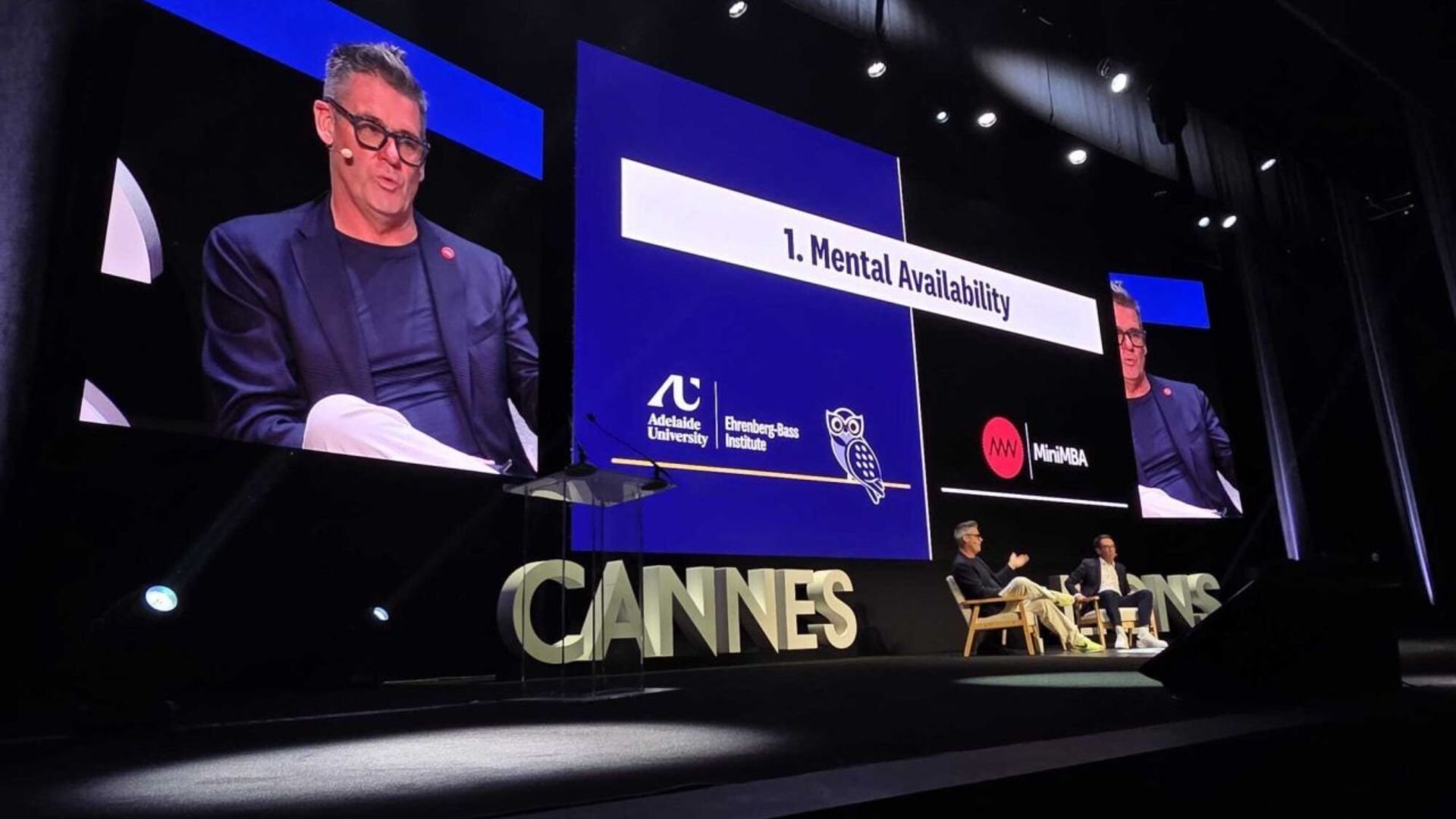
Mark Ritson and Byron Sharp at Cannes Lions 2026
Mental availability is marketing’s most important job
Mark says that 70% of the job is distinctiveness, and 30% is relative differentiation – or "Double D marketing".
Byron didn’t disagree – but thinks most marketers are “too crap to achieve it.”
DBAs are in. Brand codes out.
For a few years now, Mark has publicly called for unity among the marketing discipline. We’re not making it easy on new marketers, he says, by using all these different terms for the same thing: Distinctive Brand Assets or DBAs (Ehrenberg-Bass), Fluency (System1) and MiniMBA’s brand codes.
And to be fair to Ehrenberg-Bass, they did write the book on it (see Jenni Romaniuk’s Building Distinctive Brand Assets and how to measure DBAs using a Distinctive Assets Grid).
System1 has retired Fluency and Mark Ritson confirms he will be retiring MiniMBA’s longstanding brand codes.
Mass marketing or targeting?
Mark Ritson agrees that mass marketing is overall more effective. But stands by his own model of two-speed targeting: target the sophisticated mass market (anyone who could reasonably buy your product), then use segmentation for your short-term, performance-driven marketing to harvest that demand.
Byron, however, won’t budge on his position that segmentation is anti-penetration.
Brand purpose
Still “generally pointless” (with a caveat for brands who do it properly, wherein the ‘point’ of purpose is purpose).
Consistency
Both agree it’s important, but also that nobody does it properly or for long enough. Read: "Consistency pays double when it comes to brand codes"
To hear his festival rundown in Mark’s own words, you can watch the webinar on-demand now: Appreciating Audio with Mark Ritson
The secret to profit and trust: Audio’s impact on campaign effectiveness
Onto the main event and Mark presented the findings of a landmark global study on audio effectiveness. The headline being: audio lifts campaign outcomes in every market.
Brands who include some kind of audio in their campaign mix trigger a disproportionate uplift in campaign effects. This is what Mark Ritson calls “the catalytic effect of audio.”
The research was conducted by System1, using data from the Effie x System1 Global Databank spanning 17 years across Australia, US, UK and Ireland and Europe.
Analysing more than 1250 campaigns, the study found that campaigns with audio outperform those without audio on profit (+75%), trust (+81%), price insensitivity (+81%) and customer acquisition (+19%).
Audio is a somewhat all-encompassing term, but what we’re primarily talking about is audio as a channel – radio and podcast – included as part of your media mix. Though as you’ll see, sonic devices and jingles are part of the equation too.
We’ve summarised the key take-homes from Mark’s talk below, but for a more in-depth analysis – plus a Q&A with Mark Ritson – watch the full webinar on-demand.
Radio plays especially well with others
We already know about the benefits of integrated media communications. Spreading your ad spend across multiple channels delivers a much greater return on investment, so arguably radio could be just another channel. But what data appears to show is that audio gives a disproportionate advantage.
“The average in different countries varies from somewhere between 4% to 12% of total ad spend. So it’s not the biggest piece of the pie, but it does appear to make the other parts of the pie play better if it’s included.”
The average uplift across all countries and across 14 tested measures was +22%. And within that 22% average are some particularly juicy trends.
Over the next few slides, Mark takes viewers through the most significant audio effects – and why they matter for marketers.
-
Acquisition (+19%)
Across all campaigns with audio, the average boost in acquisition is +19%
It’s not as big a number as some of the others Mark has pulled out from the study, but in a world of mass marketing and penetration, this is no small advantage. It’s a proven driver of growth.
-
Price insensitivity (+81%)
Price, as we know from decades of research at Wharton and hammered home on the MiniMBA in Marketing pricing module, is the biggest lever you can pull to drive profitability.
This is also a particularly poignant finding because it demonstrates the role of marketing in pricing. Mark has long decried the fact that marketing has lost its seat at the pricing table. In too many companies, prices are set and handed down to marketing from another part of the building.
“But when marketers are trained in pricing…when they do have a role to play, their impact is spectacular, as you can see here.”
-
Differentiation (+16%) and brand image (+12%)
In the world of MiniMBA, this is the output of your positioning work: How your brand is perceived to be relatively different from other brands. And what images and associations you have successfully put into the minds of buyers when they think about your brand.
If you subscribe to the thinking of Byron Sharp, these things are nearly impossible to achieve. But according to the data, audio makes it a whole lot easier.
-
Trust (+81%)
Brands with audio had a stronger brand trust perception – according to System1 data and the Effie Database – to the tune of +81%.
“That’s not a surprise,” says Mark Ritson. We know that people don’t trust social media and that distrust is conferred onto the brands who advertise there. Conversely, he says, “almost every study shows that radio has this incredibly powerful trust quotient. No surprise it then transfers that trust over onto brands.”
The compounding effect of audio + good creative
Next, Mark looks at the audio data against the backdrop of some important research from System1 last year, which pinpoints the three drivers of ad effectiveness: emotion, distinctiveness and time.
Read next: Data finally shows us the “three factors” of good creative
When you combine audio with these other levers of advertising effectiveness, this is where we really see the impact of audio begin to compound.
Audio + emotion doubles profit
Emotional advertising is the only way to get consumers’ attention. Mark reminds us of the great Sarah Carter quote: "Consumers really don’t give a s**t."
Emotional advertising drives greater business and brand effects. When you add audio into the picture, it roughly doubles profit.
DBA type matters
Once you have consumers attention, they need to know that it’s you. A great ad that doesn’t easily and repeatedly tie back to your brand does nothing to drive brand or business effects.
Ads that are emotional and distinctive naturally deliver another nice profitability boost.
What System1 data shows, however, is that type of DBA matters too. While a logo or symbol is the least effective brand asset, sonic devices (like the Netflix TUDUM) and brand jingles take 1st and 3rd place respectively.
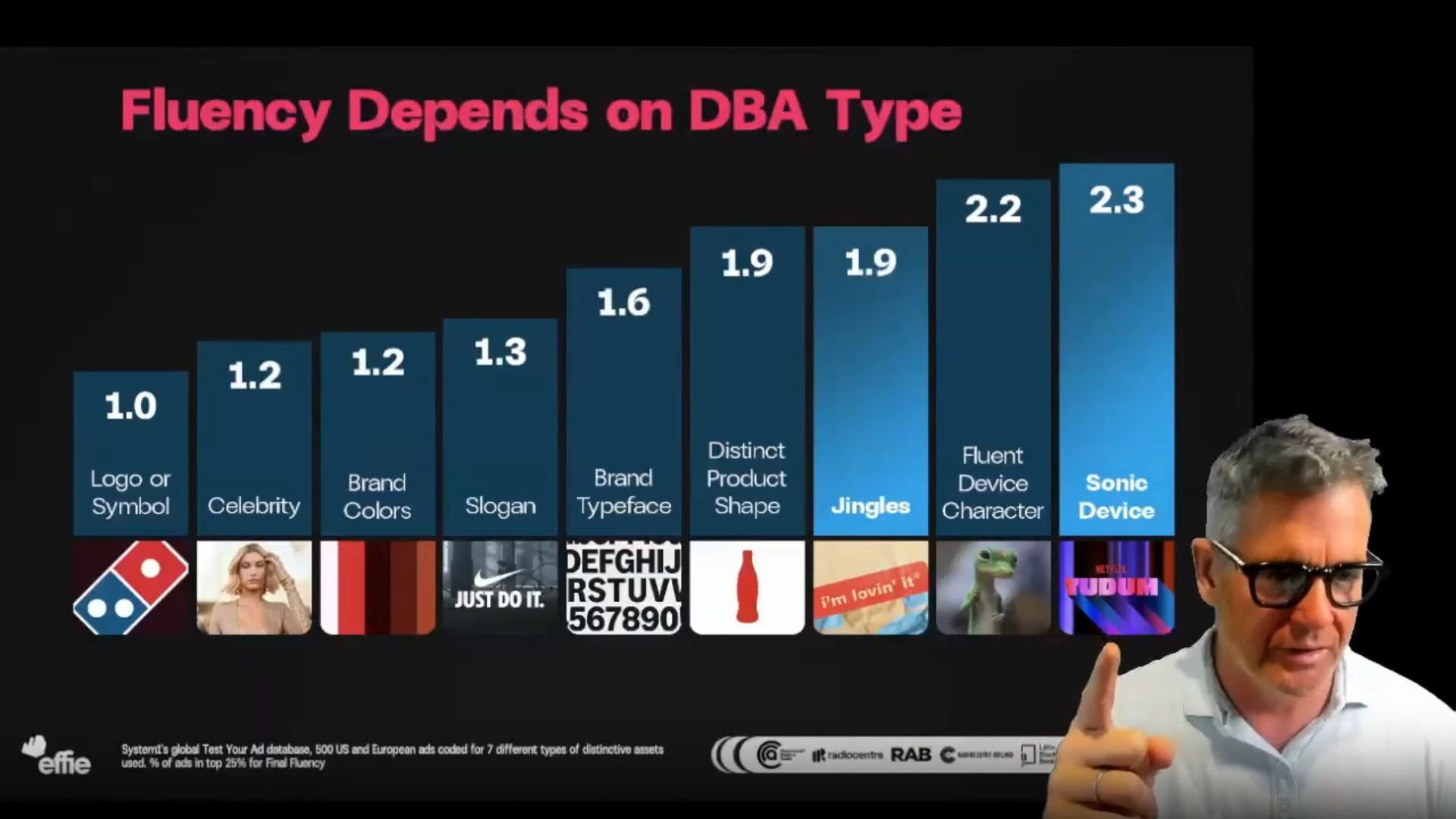
System1's global Test Your Ad database
“Audio has two of the strongest distinctive assets. We need to stop thinking with our eyes and recognise that the part of our brain that is linked to memory and bringing things to mind is much closer to auditory and smells than it is to the visual cortex.”
When you combine the effects of audio and distinctiveness, it delivers an average profitability uplift of 164 points (on a 100-baseline index).
Time is a crucial missing factor
One of the most important and certainly most overlooked effectiveness levers is the element of time – letting your campaigns “bake” and the brand effects play out, ideally for 3+ years.
We saw this in last year’s research on creative effectiveness and the pattern holds true when you add audio data.
Brands who combine all these other effectiveness factors – emotion, distinctiveness, audio – and add time will outshine their less patient counterparts. Look at McDonald’s, who has been playing the jingle game with “I’m lovin’ it” since 2003.
Long, distinctive campaigns with audio as part of that mix deliver an average uplift of 77 points.
For a more detailed breakdown of all the data, examples of great audio in play, plus some practical advice on how to apply these findings in your own work, it is well worth setting aside an hour to watch the full webinar and Q&A session with Mark Ritson.
Find it on-demand here: Appreciating Audio with Mark Ritson: Why radio and podcasts deserve more attention
Cover: New Africa / AdobeStock